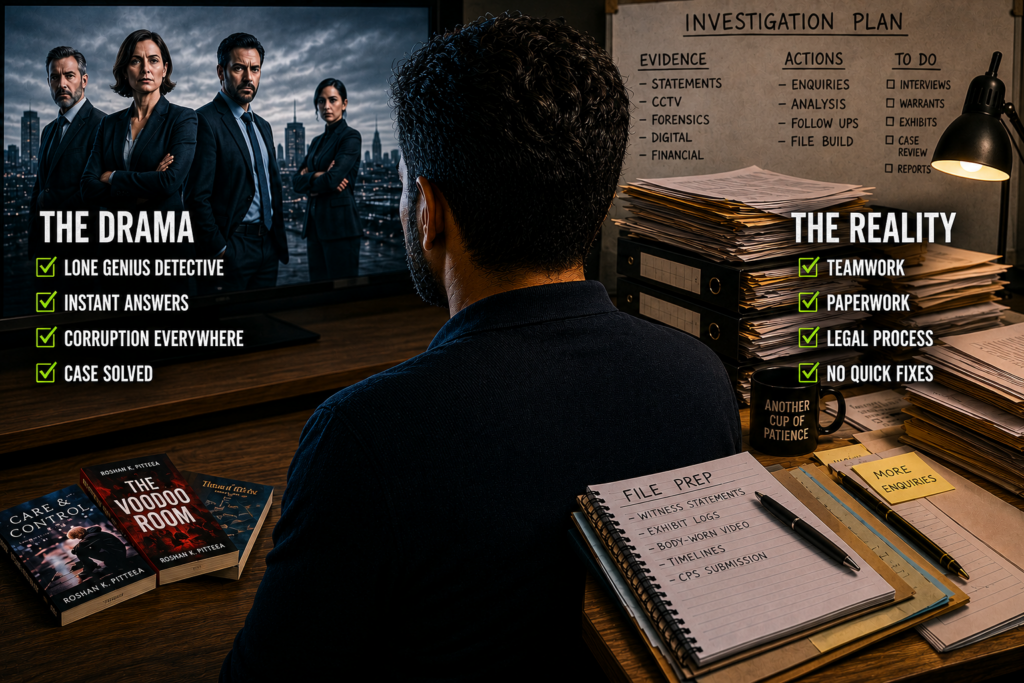
What Crime Dramas Get Wrong About Police Investigations

I love crime dramas.

I also spend a lot of my life shouting at the television whilst watching them.

Whether it's Line of Duty, Happy Valley or Broadchurch, crime dramas have given us some fantastic storytelling over the years. As a crime writer, former child protection social worker and serving police officer, I'm always there for good crime drama.

That doesn't stop me noticing the bits they get wrong.

Let me preface what I write next with this: television isn't meant to be a documentary. Writers need pace, drama and compelling characters. If every police investigation were depicted exactly as it happens in real life, most viewers would switch off after fifteen minutes of watching someone complete paperwork. And, let me assure you, there is A LOT of paperwork!

After spending a good twenty years in the safeguarding field, I can’t help but notice a few recurring myths that crop up.


Here are my big three:


1. The Detective Inspector Is Doing Everything


If you've watched or read enough crime dramas, you'll be familiar with this character. They're usually a Detective Inspector (DI) or Detective Chief Inspector (DCI).

They interview witnesses. Conduct house-to-house enquiries. Arrest suspects. Execute warrants. Analyse evidence. They somehow manage to solve every aspect of the case personally.

In reality, that's not how investigations work.

Senior detectives certainly play a vital role, but they are primarily responsible for managing investigations rather than conducting every enquiry themselves. Large investigations involve teams of detectives, forensic specialists and analysts, each with their own responsibilities.

By comparison, fictional detectives spend more time behaving like Detective Constables than Detective Inspectors. The irony is that the real structure of a major investigation is often far more interesting than the lone-genius detective model that fiction tends to favour.


2. "Let's Charge Him"

One of my favourite television moments arrives shortly before the final act.

The detective bursts into the office.

A dramatic piece of evidence lands on the desk.

Someone says, "Right. Charge him."

The reality is rather more complicated.

For many serious offences in England and Wales, the police don't simply decide whether somebody is charged. Instead, investigators prepare a file and submit it to the Crown Prosecution Service (CPS). File prep is pressured, long-winded and tedious, particularly when working against the PACE clock. I often sit in awe as I watch my teams build a file on a remand case, scripting up reports and clipping body-worn video footage.

CPS then applies legal tests when deciding whether a prosecution should proceed. That process can involve detailed discussions between investigators and prosecutors. Additional enquiries may be requested. Evidence may need strengthening. Charging decisions can take time.

Admittedly, "the detective waits three months for legal advice, only to receive an action plan for more enquiries first" doesn't make for gripping television!


3. Corruption Is Everywhere

What surprises me is how often corruption, misconduct and incompetence appear to be the norm in television policing. If that were true, policing would collapse before lunchtime.

Don't get me wrong. Police misconduct and corruption exist. When it occurs, it is serious and rightly attracts public scrutiny.

But the reality is that the overwhelming majority of police officers spend their careers trying to do the right thing, often under considerable pressure. The system is by no means perfect, but corruption is generally the exception, not the norm.

The challenge for television writers is that corruption makes for brilliant drama. Professional officers quietly doing their jobs properly tend not to generate cliffhangers.

All the same, my characters will stay well away from corruption. That’s not to say that they won’t make mistakes or face torturous moral dilemmas. To me, that feels authentic and does justice to the people I have the privilege of working alongside.


So, Who Gets It Right?

The best crime stories explore human behaviour. That's true whether the story unfolds on a television screen or within the pages of a novel. As both a police officer and a crime writer, I really appreciate a crime drama that balances a gripping plot with procedural realism.

The TV drama ‘Scott & Bailey’ does this beautifully. Led by the formidable DCI Murray, the Manchester Major Investigation Team (MIT) which includes the titular characters DCs Janet Scott and Rachel Bailey literally had me on the edge of my seat. What works particularly well is how the story focusses on all three women at home and at work (rather than just, say, Murray).

I’ve noticed more crime dramas following this trend now and it definitely works because we see the investigation from each rank’s perspective.


Final Thoughts

Despite my bugbears, I truly believe that UK crime dramas are the best in the world. Our appetite for crime, from cosy to thriller, shows no sign of slowing down. But you can rest assured that, if Care & Control and The Voodoo Room get picked up by Netflix, I’ll be insisting that Louis and Sabina keep their rank as constables!